In responding to the Parliamentary Ombudsman's report Prime Minister, Tony Blair, put the cost of meeting her demands at £15bn. The Government's response was finally published on 6/6/06 and the accompanying figures show that the costs of complying with her recommendations would be around £100m a year, rather than the totally misleading £15bn figure. The report now reveals that the real cost over 60 years comes to £2.9-£3.7bn*, which is less than the amount raised by the Chancellor in one year's worth of ACT relief that was removed from pension funds!
* These figures are also an over-estimate because they ignore the income tax recoverable and the pension credits not required. Furthermore costs can be reduced by not buying annuities and running the scheme as a combined pension fund as is the case with the PPF.
 Ros Altmann has annotated the government's response showing that the arguments are full of inconsistencies and inaccuracies. Ros Altmann has annotated the government's response showing that the arguments are full of inconsistencies and inaccuracies.
GOVERNMENT RECORD ON OCCUPATIONAL PENSION PROTECTION
WHAT GOVERNMENT SAID: |
WHAT GOVERNMENT DID: |
In 1995 Government said ‘the MFR will mean that members can be confident that the value of their accrued rights is secure, especially in the event of the scheme or the employer company winding up. It is only right that the members’ investment and their accrued occupational pension rights, should be properly protected’.
|
Behind closed doors officials told the Actuarial Profession to design the MFR formula to give only a 50/50 chance of non-pensioner members getting their full accrued pensions.
|
In 1998 DSS said it would work with the FSA to improve pension information, including promoting the awareness of the benefits and risks. ‘Government and financial Regulators have a central role to play in developing the long-term framework…People should be encouraged to join their employer’s scheme, but will only do so if they believe their pension rights are properly protected’.
|
DSS and FSA issued information leaflets only stressing the benefits of final salary schemes, but not mentioning any risks. The FSA said these pensions were ‘guaranteed’ which makes it ‘easier to plan for
retirement’. DSS said they were ‘safe’ - so people believed there was no risk.
|
 In 2000 the Actuarial Profession recommended that the MFR should be strengthened. Officials told the Pensions Minister, Malcolm Wicks, that this would restore the MFR to its original strength, but added ‘if we introduce these changes we are likely to come under pressure to similarly change the assumptions used in calculation of (contracting-out) rebates which would make them more expensive to Government. We do not have Treasury agreement to this.’ In 2000 the Actuarial Profession recommended that the MFR should be strengthened. Officials told the Pensions Minister, Malcolm Wicks, that this would restore the MFR to its original strength, but added ‘if we introduce these changes we are likely to come under pressure to similarly change the assumptions used in calculation of (contracting-out) rebates which would make them more expensive to Government. We do not have Treasury agreement to this.’
|
Government ignored Actuarial Profession and decided not to strengthen the MFR. It said it would wait for a forthcoming review of contracting-out rebates and of the MFR itself which it had asked the Actuarial Profession to carry out. |
 In 2000, Alistair Darling said ‘The public rely on Government information and they are entitled to be reassured that leaflets are accurate and comprehensive.’’ ‘ It is important should be honest about what they do…Whatever else they do, they should not put people in a position in which they do not have adequate pension security of cover.’ In 2000, Alistair Darling said ‘The public rely on Government information and they are entitled to be reassured that leaflets are accurate and comprehensive.’’ ‘ It is important should be honest about what they do…Whatever else they do, they should not put people in a position in which they do not have adequate pension security of cover.’
 Pensions Minister. Jeff Rooker, told Parliament ‘we are aware of the importance of protecting members’ rights. If we cannot do that, they have no-one else to look to.’ Pensions Minister. Jeff Rooker, told Parliament ‘we are aware of the importance of protecting members’ rights. If we cannot do that, they have no-one else to look to.’ |
In 2000, the Actuarial Profession report told Government the public thought the MFR fully protected their pension rights, and that they should be told that it does not. A DSS official wrote to the Minister that informing the public about benefits would require careful handling since this would highlight the fact that the objectives of the MFR mean that non-pensioners only have a 'reasonable' expectation of receiving their benefits.’
|
| In 2000, Alistair Darling said ‘The giving of wrong information by a department is inexcusable.’ ‘We have already tightened up procedures for checking leaflets and guidance’. |
DSS leaflets were issued which failed to mention the risks to final salary scheme members’ pensions on wind-up and told members their pensions were 'safe' ' thus giving a totally biased picture.
|
 In 2001, the Chancellor, Gordon Brown, said he was determined to protect the long-term security of pensioners and other pension scheme members in occupational schemes’. In 2001, the Chancellor, Gordon Brown, said he was determined to protect the long-term security of pensioners and other pension scheme members in occupational schemes’. |
In 2002, the MFR was weakened a second time and in 2003, the Government ignored actuarial profession’s advice that the MFR had become much too weak and needed to be strengthened urgently.
|
| In 2004, Government announced a £400million Financial Assistance Scheme claiming ‘this represents significant help to those who have lost the most’. |
The FAS has only helped about 50 people. Meanwhile, scheme money is sitting in a bank but Government has refused to allow trustees to pay money immediately Even those who are terminally ill, or already in their late 60s
|
Latest News: The Ombudsman's concerns about the government's rejection of her report (28/6/06) "The Government's response:
- fails to address the basis on which I found that maladministration had occurred;
- makes selective use of the comprehensive and detailed evidence set out in my report;
- provides an unbalanced view of the role of Government in the system of final salary occupational pension provision; and
- misrepresents what my report says about the causes of financial loss."
Gordon Brown said: "There is clear and unmistakable evidence in the Ombudsman's report of five significant areas of maladminstration by the Department [..], many pensioners have lost their life savings, and retired workers their redundancy payments. I must ask why we have had to rely on the Ombudsman to confirm the mismanagement and incompetence that was widely known about more than one year ago. Does the Secretary of State agree that the House will find it strange that he continues to deny the Government's responsibility for mistakes and does not even apologise for his department's role". However he said this on 19th December 1989 about the Barlow Clowes report. |
|
 Tony Blair said : I accept and understand entirely the sense of loss and anger and anxiety in respect of those that have lost their pensions, which they have paid for many, many years, but we are being asked to give on behalf of the taxpayer a £15 billion commitment. We simply cannot do that in circumstances where the reason for the loss is the collapse of those pension schemes themselves. Tony Blair said : I accept and understand entirely the sense of loss and anger and anxiety in respect of those that have lost their pensions, which they have paid for many, many years, but we are being asked to give on behalf of the taxpayer a £15 billion commitment. We simply cannot do that in circumstances where the reason for the loss is the collapse of those pension schemes themselves.
 Secretary of State for Work and Pensions, John Hutton, said: “I don’t think that the taxpayer can be held liable for the failure of these private pension schemes. Absolutely not. I don’t think there is any evidence that the leaflets were inaccurate or incomplete in the way that the parliamentary ombudsman has indicated.” Secretary of State for Work and Pensions, John Hutton, said: “I don’t think that the taxpayer can be held liable for the failure of these private pension schemes. Absolutely not. I don’t think there is any evidence that the leaflets were inaccurate or incomplete in the way that the parliamentary ombudsman has indicated.”
 Welfare Reform Minister at the DWP, Margaret Hodge, said that to compensate the victims would mean 6p on Income Tax. From the government figures now released the actual figure is 0.00004p ! Welfare Reform Minister at the DWP, Margaret Hodge, said that to compensate the victims would mean 6p on Income Tax. From the government figures now released the actual figure is 0.00004p !
 John Tiner, Chief Executive of the Financial Services Authority, said of the FSA guide to occupational pensions "We never said that 'guaranteed' means 'guaranteed in all circumstances' ". John Tiner, Chief Executive of the Financial Services Authority, said of the FSA guide to occupational pensions "We never said that 'guaranteed' means 'guaranteed in all circumstances' ".
Related links:  BBC Moneybox - views of the public BBC Moneybox - views of the public
 Crocodile Tears for Pensioners Crocodile Tears for Pensioners
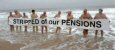
Pensions Action Group
Parliamentary Ombudsman's Report
More on the Financial Assistance Scheme
The case is now subject to a judicial review - see press release
House of Commons Public Adminstration Committee, 28th June '06:
 Ann Abrahams to John Hutton: "It WAS maladministration, so get over it". Ann Abrahams to John Hutton: "It WAS maladministration, so get over it".
John Hutton's article (8/7/06) in the Money Telegraph responding to Ros Altmann's case has resulted in a storm of correspondence.
 See also Ros Altmann's slides of a presentation to a meeting of MPs in the House of commons on 11 July '06 See also Ros Altmann's slides of a presentation to a meeting of MPs in the House of commons on 11 July '06

Now read what Saga says about the case and sign their petition
|


