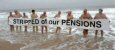
The then Secretary of State for Work and Pensions, Pete Hain, finally agreed to PPF level compensation for the FAS victims on in a statement on 17th December 2007. The then Secretary of State for Work and Pensions, Pete Hain, finally agreed to PPF level compensation for the FAS victims on in a statement on 17th December 2007.
The unions, Community and Amicus, claimed that the government climb down was due to their action in going to the European Court of Justice but the view of the Pensions Action Group who fought for justice for 7 long years is rather different:
 Ros Altmann writes: The Government did not eventually act on this to comply with any EU verdict. In fact, there was no European Court judgment which said they had to do anything, quite the contrary. The Court referred the case back to the UK Courts to decide what to do, but actually the European judges said that the UK Government was not obliged to pay PAG members anything. The judgment said the Government would only need to pay compensation for the lost pensions if it was guilty of 'gravely and manifestly disregarding' EU law, and the judges specifically said they did not think that the UK Government had actually gravely and manifestly disregarded the EU Insolvency Directive! Ros Altmann writes: The Government did not eventually act on this to comply with any EU verdict. In fact, there was no European Court judgment which said they had to do anything, quite the contrary. The Court referred the case back to the UK Courts to decide what to do, but actually the European judges said that the UK Government was not obliged to pay PAG members anything. The judgment said the Government would only need to pay compensation for the lost pensions if it was guilty of 'gravely and manifestly disregarding' EU law, and the judges specifically said they did not think that the UK Government had actually gravely and manifestly disregarded the EU Insolvency Directive!
Then the EU judges also said that, in future, the UK Government did not need to protect pensions in full anyway - and it gave no specific level of protection that it thought was appropriate, other than to say that it should be more than 50%
This meant that the PPF level of compensation did not need to be increased to pay more than the 90% level.
The EU judgement in the Insolvency Directive case was, in reality, very damaging for us, because it took away any hope of 100% compensation! Once the EU judges specifically said that the Government DID NOT have to pay 100% in future, the maximum we would get became PPF level! It also specifically suggested that, in the view of the EU judges, the Government was not obliged to compensate FAS victims at all, so we had to keep on with our own legal case to prove that the Parliamentary Ombudsman could not just be ignored as Government had tried to do and that the Government's rejection of the PO report was unlawful. This was the case we put and what has now been confirmed by the Court of Appeal and also now accepted by the Government because they are no longer going to appeal to the Lords.
But this case was separate from the EU case (it also covered solvent employer schemes which were not at all involved in the EU case). All the EU judgement did was to say the Government had no obligation to compensate 100%, also that it thought the UK Government may not need to compensate at all in this case and then referred the matter back to the UK Courts for a final verdict. The unions would then have had to go back to court here in this country to try to get UK judges to come to a different conclusion from the EU judges.
Fortunately, our Judicial Review case has succeeded in proving that the Government's rejection of the PO report IN THIS CASE was unlawful and that it had to consider properly compensating all those affected - including solvent employer schemes. Last December's announcement was the first part of this, but individuals may want to appeal separately and directly about their own particular circumstances to the DWP on the basis of the maladministration and how it affected them personally, if anyone wants to establish that their particular case merits more than the global solution will give.
So there is no 'gun' pointing at the Government's head from the EU case as far as I can see and, in any case, the referral back to the UK Courts would take another year or two, plus a further year or two for appeals etc! The only way that the unions could then prove 'grave and manifest disregard' for the protection of your pensions would be to use the PO report, as this was not argued in front of the EU judges. In other words, the real verdict against the Government comes from the Judicial Review and also our pressure on them through demonstrations and media. The EU judgement was not helpful at all and, in any case, did not cover all
|