The following is an extract from the debate on the amendments suggested by the OPA on 18th May. The proposed amendments were withdrawn after the Minister for Pensions, Malcolm Wicks, undertook to table another amendment in the Lords:
Mr. George Osborne: .. The amendments are inspired by the Occupational Pensioners Alliance, which represents more than 1 million occupational pensioners, and concern points that were brought to our attention by Mr. Roger Turner of that alliance. They are designed to ensure that member-nominated trustees reflect the interests of pensioner members as well as active members...
..Amendment No. 15 would require that of the one third of trustees required to be member-nominated, one third of those should be nominated by a recognised pensioner association. Amendment No. 17 seeks to define that as
"an organisation that represents at least 25 per cent. of pensioners from a particular occupational pension scheme".
That would provide a threshold so that it was clear that the pensioner association genuinely reflected the interests of a number of pensioner members, rather than being a group that had been put together to speak for only one or two members.
It is worth repeating what the Occupational Pensioners Alliance has said on that:
"We are particularly unhappy about the proposals . . . on Member Trustees"
because
"the role of pensioners in the running of their schemes would be even more marginalised than it is now."
The practical upshot of the Bill will be that
"pensioners can be ignored in the nomination and election processes. There is only a duty for 'active members' to be consulted. The OPA believes strongly that representation via the Trustees is essential for good and fair scheme management and we call, in the strongest possible terms, for the Government to re-examine its position on this issue."
The amendment therefore attempts to get the Government to re-examine their position and deal with the under-representation of pensioner members.
As the legislation currently stands, one can envisage a situation in which a very mature scheme had one third of its trustees-the third that were member-nominated-elected by a minority who were the active members. Or there could be a scheme whose trustees were able to choose the member-nominated trustees themselves. The inclusion of pensioner members would help to prevent that abuse, and would also, we hope, lead to a more open, transparent process.
Under amendment No. 16, member-nominated trustees would have to be nominated and selected by a process in which
"at least all active and pensioner members"
took part; at the moment, the requirement is only that active members are involved in the nomination. Amendment No. 18 would extend that to the process for member-nominated directors. Amendment No. 19, on governance, is not only about pensioner members, but is a broader point. It would require the whole process of choosing member-nominated trustees to be fair and open. It would simply insert three words into the Bill, but would give the courts some leverage when dealing with unfair and closed processes. Amendment No. 21 would extend that requirement to member-nominated directors.
Trustees are ultimately the best defence against the mismanagement of pensions, and we believe that member-nominated trustees are the best defence of the interests of members. We think that those members should include pensioner members who, in many schemes, make up a significant number of the scheme's members, and that the process of choosing the member-nominated trustees should be fair and open. It is vital that pension schemes are accountable to all their members, and that all members are treated fairly.
Malcolm Wicks: ..I hope that the hon. Gentleman will forgive me if, in view of the time, I do not consider all his amendments; rather, I shall cut to the quick and concentrate on where I can be helpful. Amendments Nos. 16 to 18 are not ideal. It is far from clear that establishing such a demanding minimum as the involvement of all active and pensioner members in these processes is sustainable. However, the amendments may well be a starting point in ensuring basic equality between active and pensioner members. We want to explore whether that can be done, while keeping the essence of the new legislation in its current form. Of course, we had a useful debate on this issue in Committee.
If the hon. Gentleman is prepared to withdraw the amendment, we will certainly think further about the need to involve pensioners, as well as active members, in the processes for member-nominated trustees, with a view to tabling our own amendments on this issue in another place. I hope that those helpful remarks might encourage the hon. Gentleman to withdraw the amendment.
Mr. Osborne: ..Yes, as I am advised to say by the Government Whip, that is very helpful. I am glad that the Minister is prepared to consider the case for pensioner members. The Under-Secretary of State for Work and Pensions says that I should say "Thanks." I shall do so once I have seen the Government amendments in the other place, but I am sure that the Occupational Pensioners Alliance will be extremely grateful. I look forward to the telephone call from the Minister, and with that, I beg to ask leave to withdraw the amendment.
More..
|
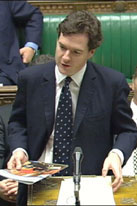
George Osborne, MP for Tatton:
Malcolm Wicks replies: ..we will certainly think further about the need to involve pensioners, as well as active members, in the processes for member-nominated trustees, with a view to tabling our own amendments on this issue in another place.
|
|


